Saint Benedict

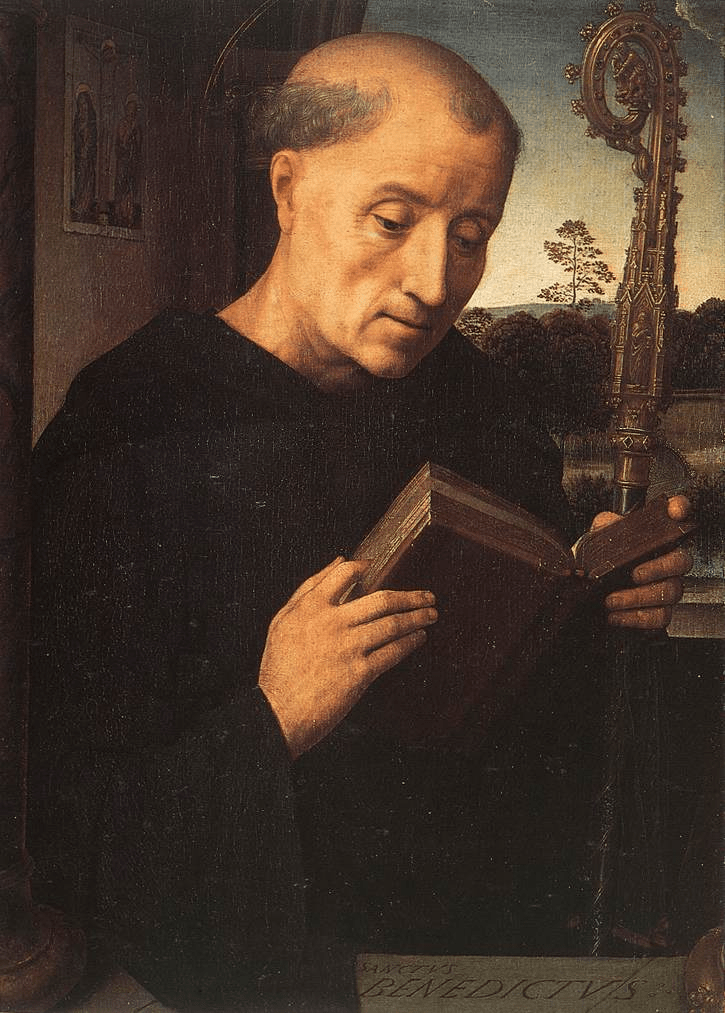
Benedict was born into a well-to-do, Christian family in Nursia, Italy, around the year 480 and was sent to Rome to be educated when he was a teenager. He was revolted by the immoral behavior he saw there, so he quickly left Rome with his nurse (a caregiver-turned-housekeeper) to live a life of solitude in the mountains. Soon he realized that God was calling him to an even greater abandonment of the world. While he was searching for a place to live in complete solitude, he settled on the city of Subiaco, where he met a monk named Romanus. Romanus brought bread to Benedict every day (disobeying the monastery’s rules), while he lived in a nearby cave for three years. When other men found out about Benedict’s holiness and simple way of life, they wanted to follow him. Benedict settled the men who wanted to be his disciples into twelve separate monasteries, with twelve monks in each. Unfortunately, the monks began to resent him, and they even tried to poison him. (Benedict later decided that he had been too severe with them.) When the cup they tried to poison him with broke after he had blessed it, he recognized what they’d tried to do. He repented of his past severity with them and left them suddenly. He moved to Monte Cassino, the site of a former pagan temple, and around the year 530, he and those who followed him began to build a monastery. This ultimately became one of the greatest monasteries that the world has ever known. Learning from his experiences at Subiaco, Benedict gathered all his monks into one monastery, developed his famous rule for monastic life, and established the practice of ora et labora among his monks, in which they lived a structured life of both prayer and work. He cared for the sick people who lived outside the monastery and the poor who came to the monastery for alms and food. Benedict died in the year 547 as he stood in the monastery’s chapel, with this arms supported by his brothers and his hands lifted up to Heaven.

Saint Joseph (Mar. 19)

Homily for the Feast of St. Joseph

by Fr. Josh Leigeber

IN+J

What an incredible example Saint Joseph is of humble faith! And an example that hits home, perhaps, a little bit more than some of the other saints we remember. Because, admittedly, a good many of the saints’ days observed in the Church’s calendar are apostles, priests, bishops, theological doctors, martyrs—and as a result, in some ways, they may sometimes seem far-removed from our day to day experience, and even, perhaps, other-worldly.

But Joseph, who, other than the Blessed Virgin, is one of the most consequential saints remembered in the liturgical year, was none of those things. He was simply a husband, and a layman, and a simple worker. His saintly example is all bound up in the fact that Joseph quietly fulfilled his family vocations of being a guardian, protector, and provider for the Blessed Mother and for our Lord Jesus Himself. As such, we see in Saint Joseph a shadow of the Heavenly Father who is the guardian, protector, and provider for us all, and an image of what being a faithful husband and father looks like. 

In particular, we see how within those vocations, Joseph’s faithfulness comes as a result of—and together with—his humbly and faithfully listening to the Word of God and doing whatever it is that God has given him to do. Joseph never hesitates to obey, and he never draws attention to Himself. The only word he is recorded as saying in the Sacred Scriptures is at the birth of our Lord when he calls His name JESUS, in accordance with the divine angelic pronouncement that the Child will save His people from their sins. Joseph simply follows God’s direction and command, and as a result, he lives a life of strong and yet modest care and self-giving to Mary and Jesus. He just fulfills his vocations and follows the Word of God.

Husbands and fathers: you too are called to be guardians, protectors, and providers for your wife and your children. This is the vocation you have been given and what God has called you to. And you are to fulfill those responsibilities never from a posture of being overbearing or harsh, but from a position of strong yet humble love and self-giving. And in that Saint Joseph is your model. This means that you are called to lead your household; to guard your family (with God’s help) from the influences of the devil and the world. And most of all, it means that you are to hear and heed God’s Word and to make Christ and the Word of Christ central within your family’s life.

Everyone: like Blessed Joseph, you too are called to be faithful laypeople who listen to the Word of God, cling to Christ, and do whatever it is God has given you to do within your various vocations. You have not been called to be apostles, priests, bishops, theological doctors, or God-willing, martyrs, but you have all been given particular callings from God and vitally important responsibilities within those various callings. As you seek to carry them out, strive to follow the example of Saint Joseph by submitting to God’s Word in all humility and, within your daily life and the living out of your vocations, to guard and protect, like Joseph, the dignity of the sacred life and confession of Jesus. And as you do, through Jesus, who has saved you from your sins, you will be temporally and eternally blessed. 

IN+J

Saint Patrick

Saint Patrick was born in Britain around the time of the late 4th or early 5th century. His family were of modest means, his father being a Romano-British senator, tax collector, and deacon of the church. At some point in Patrick’s early life, probably his teen years, his family’s villa was raided by Irish pirates, and took him as a slave to Ireland. His captors had him tend sheep and he lived in horrible conditions. In his Confessio, an early autobiographical account of this life, he claims that while in his youth he was not particularly devout, he turned to God for strength in his captivity. Some years later, he escaped his captors, and convinced a boatman to sail him back to Britain to find his family. When disembarking, him and his party wandered the wilderness for weeks, nearly succumbing to starvation. His insistence that God would provide came to fruition, where the party finally happened upon some wild boar. This gained respect and trust from those around him, leading them to Christ.

During his early 20’s, Patrick continued to study Christianity and grow in his faith. One night he was given a vision, that he would return to Ireland and convert his captors. Acting upon this, he landed at county Wicklow in Ireland, where he was not welcome. He spent much of his early time in Ireland avoiding hostile pagan chieftains, but baptized and converted many to Christ throughout his travels. Legend says that during a sermon to the pagans, he plucked a clover from the ground near his feet and used it to explain to them the Trinity.

Eventually, Patrick arrived at the court of King Lóegaire, the high king of Ireland, where Druid priests displayed their demonic magic, theatrically plunging the hall into darkness. Instead of cowering in fright, Patrick observed aloud that these priests could create darkness but that they could not dispel it–which they could not. He then proceeded to use this incident as the theme of a sermon, in which he likened Christ to the light. Many of the assembled nobles converted to Christianity that day, and Patrick gained the king’s respect and protection.

In many ways, Patrick was more Irish than the Irish. He loved Irish legends, poetry and songs, and he insisted that this heritage be documented and retained. For their part, the Irish loved him and embraced him. Patrick lived his life in Ireland and died there. He left behind a Christian people, a civilized people, and he left behind towns, schools, seminaries and a love of learning perpetuated to this day.

The text of [Lutheran Service Book 604], “I Bind unto Myself Today,” is attributed to St. Patrick. This beautiful prayer, traditionally called “St. Patrick’s Breast-Plate,” is supposed to have been composed by Patrick in anticipation of his victory over paganism. The translation of the prayer in [Lutheran Service Book] from the old Irish text is a paraphrase by Cecil F. Alexander [1818-95]. The “Apostle of Ireland,” as Patrick is sometimes called, is also associated with the shamrock, which he used to explain the Trinity. “I Bind unto Myself Today” also deals with the topic of the Holy Trinity.

St. Gregory the Great

St. Gregory was born into a wealthy Christian family in the year 540. As a young man he studied law and quickly became governor of Rome as a result of his superior legal acumen. However, God ultimately led him to serve the Church through his talents and resources.

After the death of his father, Gregory turned his villa into a monastery dedicated to St. Andrew and took up the monastic life for himself. What he didn’t spend on religious buildings he gave away to the poor. Gregory’s dedication to charity and almsgiving lasted his whole life, but Gregory was not destined to remain a monk. He reentered the public sphere and was ordained a deacon by Benedict I and later ascended to the bishopric of Rome following the death of Pope Pelagius. During this time disease broke out, turning Gregory’s attention not only to his new role, but especially to the needs of the sick and needy in the face of an epidemic.

Gregory also is known for instituting the first ever large-scale mission work from Rome, known as the Gregorian mission, to convert the pagan Anglo-Saxons in Britain to Christianity. His chosen missionary was a monk by the name Augustine, who became the first Archbishop of Canterbury, and was known as the “Apostle to the English”.

Gregory’s faith left him no option but to lead a life of servitude and humility, not only in regard to his neighbors but also in matters of the Church’s worship. His liturgical reforms were aimed at creating continuity in faithful worship, like when he had a companion to the missal made specifically for the priests and supported musical development in the Church. These had some influence on the simplified compositions created for choirs, what is known today as Gregorian Chant. Gregory’s habits of ensuring that the poor were served, creating concord with neighboring peoples, and sending out missionaries makes him stand out as an early Church father.

(Adapted from: Festivals and Commemorations, by Phillip H. Pfatteicher)

Saints Perpetua and Felicitas

Perpetua and Felicitas were Christian women who lived in Roman-controlled Carthage in North Africa in the late second and early third centuries. Perpetua was a young, married noblewoman and new mother; Felicitas was a slave, who was pregnant when she was arrested. The two were catechumens, part of a group of newly converted Christians preparing for Baptism who were arrested for their illegal faith. Christianity was seen as anti-social by the Roman government, who enforced a polytheistic paganism that blended together lots of cultures’ native religions, in an attempt to keep the peace across their huge empire.

Perpetua’s father, who was not a Christian, visited her in prison three times to convince her to renounce her faith and save her life. He tried violence to scare her, he tried asking her to think of him and of her infant son, he tried grieving and great shows of emotion. Perpetua was deeply upset, but she refused to change course: She confessed that she was a Christian, prayed for and tried to comfort her father, and still refused to offer sacrifices to Caesar or renounce Jesus. For this, Felicitas and the others were condemned to the wild beasts in the amphitheater games held in honor of the emperor’s birthday. During their time in prison awaiting their fates, Perpetua was baptized, and Felicitas gave birth while in prison. It was illegal to execute a pregnant woman, and Felicitas had been worried that she would not be able to face martyrdom with her friends. She went into labor a month early, and so faced death alongside her brothers and sisters in Christ.

The Christians eventually went to their deaths in the colosseum with quiet joy and courage, in sure hope of Christ’s love and His promise of resurrection. While facing down the wild animals, Perpetua stopped to fix her hair, so that she would not appear disheveled or in mourning, and helped Felicitas back on her feet after she was trampled. They ultimately died by the gladiator’s sword. The editor of Perpetua’s prison diary describes the Christians’ deaths, noting that, before they died, they kissed one another with the kiss of peace.

(Adapted from The Lutheran Witness; “Our Great Heritage: Perpetua and Felicitas”, by Molly Lackey)

St. Matthias, Apostle

Yesterday (Feb. 24), the church celebrated the Feast of St. Matthias, Apostle. Matthias was one who was among the disciples of Jesus during his earthly ministry. The Early Church fathers held that he was one of the 72 sent out by Jesus in Luke 10:1-20. Following Jesus’ ascension, Matthias was chosen by lot to be the twelfth apostle after Judas’ betrayal and suicide. Scholars posit that he went either to Ethiopia or Armenia. He was martyred for the faith, possibly at Colchis in Asia Minor and around 50 AD. The Church of St. Matthias in Trier, Germany claims the apostle is buried there, making him the only apostle buried north of the Alps in Europe.

Let us pray: “Almighty God, You chose Your servant Matthias to be numbered among the Twelve. Grant that Your Church, ever preserved from false teachers, may be taught and guided by faithful and true pastors; through Jesus Christ our Lord, who lives and reigns with You and the Holy Spirit, one God, now and forever.” Amen.

Description adapted from and prayer quoted from “Treasury of Daily Prayer,” 1236-1237.

Saint Juliana of Nicomedia

Saint Juliana Virgin Martyr aged 18 (of Nicomedia) | Flickr

Juliana (b. 285) lived during the Christian persecution under the Roman emperor Diocletian. She was betrothed to Eulogius, the prefect of Nicomedia, but refused to become his wife unless he accepted the faith of Christ. Her father therefore commanded that she be stripped and soundly beaten, then handed her over to the prefect. When Eulogius asked why she continued rejecting him, Juliana responded, “If you will adore my God, I will consent, otherwise I will never be yours!” Eulogius answered that he could not do so because the emperor would have him beheaded, to which Juliana replied, “If you are so afraid of a mortal emperor, how can you expect me not to fear an immortal one? Do whatever you please, because you will not be able to win me over!” According to tradition, Juliana was thereafter tortured in many ways, including being beaten and hung up by the hair of her head for half a day. Afterward, she was bound in chains and put in prison, where it is said that a demon appeared to her disguised as an angel of the Lord and tried to convince her to give up the faith and so spare herself further torture. Juliana refused. In the end, Saint Juliana was beheaded for refusing to deny Christ. The year was 304. (Adapted from The Golden Legend)

Saint Valentine

There once lived, in the twilight of Rome’s grandeur, a humble priest named Valentine. He walked those ancient streets under the watchful eyes of statues and emperors, but his heart beat for a Kingdom not of this world. The age was that of Emperor Claudius II, who saw fit to forbid Christian marriages—believing that soldiers, untethered by wife or child, would better serve his legions.

Yet for all that Rome considered wise in war and statecraft, Valentine recognized a higher wisdom. In the words of Tertullian, one of the early Fathers, “What has the Emperor to do with the Christian, save to learn that Christ’s kingdom is not of this world?” Still, Claudius decreed the banning of Christian unions. The priest Valentine dared to minister in secret, solemnizing the vows between Christian men and women who would not be robbed of the sacred blessing of marriage.

“For this reason a man shall leave his father and mother and be joined to his wife, and the two shall become one flesh” (Ephesians 5:31).

These forbidden weddings, carried out by candlelight in hidden chambers, were Valentine’s gentle rebellion. He believed that, in God’s design, love—especially the love that binds husband and wife—carries within it an echo of the divine. Even in the gloom of persecution, he offered hope, for “love bears all things, believes all things, hopes all things, endures all things” (1 Corinthians 13:7).

It was not long before the Roman officials turned their dark attention upon him. Love, when nurtured in the face of cruelty, tends to shine all the brighter, and such a light cannot easily hide itself. Arrested and imprisoned, Valentine found himself behind cold, unyielding bars. Roman records say that he healed a jailer’s daughter who had lost her sight. She came to see not only with physical eyes but, as the legend goes, gained the spiritual sight to embrace Christ.

Some traditions whisper that he signed a final note to her with the words “From your Valentine.” Perhaps that detail has grown with time, but it illustrates well the warmth of this man’s heart—compassion that would bloom into legend. In the spirit of St. Augustine, who wrote that “love is the beauty of the soul,” Valentine’s every action seemed a testament to that singular virtue.

Alas, the hand of Rome was relentless. Valentine, who would not betray his Lord or his calling, was subjected to beating, torture, and, ultimately, the sentence of death. On the 14th of February—around the year 269 AD—he was beheaded. It was a grisly end in human terms but, in Christian conviction, it was the very gateway into eternal life.

Indeed, if we reflect upon his final hours, we might recall the counsel of another Church Father, Ignatius of Antioch, who wrote, “It is better for me to die in Christ Jesus than to be king over the ends of the earth.” Valentine’s sacrifice, crowned in martyrdom, proved that no earthly power could rob him of his divine inheritance.

(Adapted from Saint Valentine, by the folks at Ecclesiastical Sewing | ecclesiasticalsewing.com)

St. Scholastica

Scholastica (d. 543), twin sister of Saint Benedict, was born into a good family in Nursia, Italy. Scholastica lived a holy, secluded life before she founded a nunnery, but under Benedict’s direction. She and Benedict met only once a year and only for one day. The last time they met, when Benedict started to leave, Scholastica–believing she was soon to die–objected and begged him to stay. Benedict refused, saying that his Rule obliged him to return to the monastery. Scholastica bent her head and prayed, and a violent storm broke out. A brother to the end, Benedict blamed his sister for the storm and asked what she had done. Scholastica replied, “I asked a favor of you, and you refused it. I asked it of God, and he has granted it.” Since Benedict couldn’t leave, they spent the night talking about holy things and the joys of heaven. When Scholastica died three days later, Benedict is said to have seen a vision of her soul flying up to Heaven like a dove.  (Adapted from Saints: Becoming an Image of Christ Every Day of the Year, by Beutner)

Saint Dorothy

Dorothy was a Christian from Caesarea, a region now in modern Turkey, who consecrated herself to Jesus Christ. During the persecution of Christians under the Roman emperor Diocletian in the year 311, she was arrested and condemned to death. According to tradition, as she was taken to her execution, a lawyer mocked her faith, but she told him she would send him flowers from Heaven. When he unexpectedly received roses after her death, he converted to the faith.  (From Saints: Becoming an Image of Christ Every Day of the Year, by Beutner)