Serenus the Gardener, Martyr

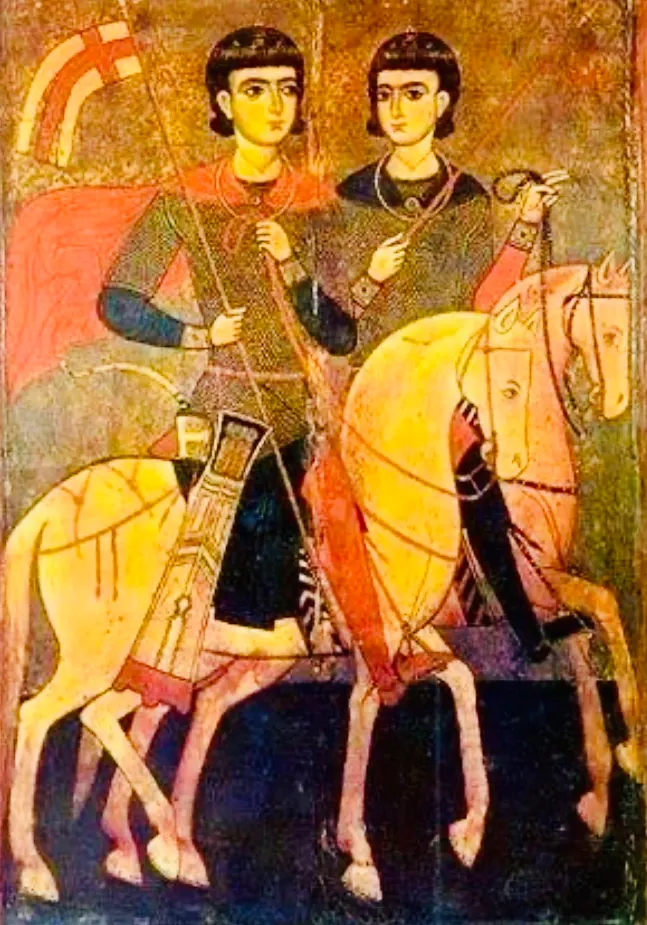
Serenus, a native of Greece, was born during the reign of Emperor Maximian. He chose to renounce all his possessions and lead a life of asceticism and prayer. He sustained himself by living off the produce of his garden in Syrmium, located in the province of Pannonia (Mitrovica in present-day Croatia). During a period of persecution against Christians, he concealed himself for several months, but later resumed his quiet life in the garden, keeping his Christian faith unknown. Being a handsome and diligent young man, he earned the respect of all who crossed his path, especially that of the wife of one of Maximian’s guards. She went from showing regard to making unwelcome advances towards him.

Serenus admonished her, reminding her that it was unseemly for a lady to be seen outside during the dangerous hour of siesta, and that by doing so, she was needlessly dishonoring herself and her husband. Spurned by his rebuke, she wrote to her husband, falsely accusing Serenus of insulting her. The husband journeyed to Syrmium, presented the letter to the governor, and thus initiated a trial against Serenus. However, he defended himself so ably that the lady’s husband became convinced of his wife’s wrongdoing, leading to the withdrawal of the charge against Serenus.

Despite being cleared of the accusations, the suspicion of the governor was aroused, for he believed that anyone so conscientious in such matters must be a Christian. Serenus was charged with this and was urged to make a sacrifice to the pagan gods. Firm in his faith, he unhesitatingly professed his Christianity, refused to offer sacrifice, and expressed a willingness to die, declaring, “I may have a part in His Kingdom with His saints.” His wish was swiftly granted, as he was beheaded. It happened about the year 307. (Adapted from Butler’s Lives of the Saints)

Faustinus & Jovita, Martyrs

St. Faustinus and St. Jovita, born into a noble family in Brescia, Italy in the early second century, exemplified unwavering devotion to God from a young age. They fearlessly professed their Christian faith during the persecution of Hadrian, earning widespread recognition for their deep piety. Ordained by the bishop, Faustinus served as a priest while Jovita became a deacon. According to tradition, as they fearlessly preached the Gospel in the region, they were apprehended by a pagan officer named Julian. In the face of pressure to worship the sun, they boldly proclaimed their adoration for the living God, who had created the sun to illuminate the world. Their steadfast faith led to torture and, ultimately, their beheading around the year 120.

Valentine, Priest, Martyr

St. Valentine resided in Rome under the reign of Emperor Claudius. A skilled physician and a devoted priest, he emerged as one of the most revered martyrs of the third century, meeting his martyrdom in the year 270. The tale recounts that on the day of his execution due to his unwavering Christian faith, he left a message of encouragement for the child of his jailer. The note, inscribed on an unusually shaped piece of parchment, became the prototype for the heartfelt messages and cards exchanged in what numerous nations now commemorate as Valentine’s Day. Other stories and traditions suggest that St. Valentine fervently worked to convert pagans, an effort that was not well-received by the pagan Roman government. Additionally, it is said that he united Christian couples in matrimony, defying the prohibitions set by the pagan regime, hence earning him the esteemed title of the patron saint of the married and those in love. (adapted from Treasury of Daily Prayer)

Polyeuctus, Martyr

ORTHODOX CHRISTIANITY THEN AND NOW: Holy Martyr Polyeuktos of Melitene in  Armenia

Already by 377, there is a church in Melitene in Armenia dedicated to the memory of Polyeuctus. He came from a Greek family and was an officer in the Roman army. He was converted to faith in Christ by a Christian friend. Subsequently, the two were arrested, tortured, and condemned to death, possibly during the persecution of Decius, emperor from 249 to 251, or, as more generally accepted, in the year 259 under the emperor Valerian. In a way akin to Saint Job in the Old Testament, the Acts of Polyeuctus include entreaties from his wife (and son) for him to give up and give in to the torture, i.e. to renounce Christ, in order to escape martyrdom. But it is said that the more they did so, the more he urged his wife to abandon her idols and cling to Christ. Polyeuctus was eventually beheaded for his faith.

Saturninus, Dativus, & Companions, Martyrs

Saints Saturninus, Dativus, and Companions (sometimes referred to as the forty-nine martyrs of Abitina) died under the persecution of Diocletian in 304. The emperor’s edict included the order to destroy all copies of the Scriptures with fire and to give up meeting together. Many Christians obeyed, but many more refused. Saturninus was a priest in Abitina, in North Africa. He and his congregation were arrested one Sunday by one of the local magistrates and a group of soldiers. All of the Christians–both women and men–were incredibly brave, speaking boldly of their faith in Christ. In particular, their interrogators were interested in getting a confession of their taking part in the assembly of Christians (the Mass, or Divine Service). One of them answered: “Sine dominico non possumus” – we cannot live without this thing of the Lord, referring to the Blessed Sacrament of the Eucharist. The martyrs were not executed but died in prison, either from prolonged exposure to harsh conditions or from the effects of the tortures they underwent.

Apollonia of Alexandria, Virgin, Martyr

Apollonia (d. 249) was a consecrated virgin and deaconess living in Alexandria, Egypt. There were festivities taking place to commemorate the millennium of the founding of Rome, when an anti-Christian riot broke out. After killing two other Christians and pillaging still others’ houses, a mob also seized Apollonia since she was a leader in the local Christian community. Here is what Eusebius relates in his Ecclesiastical History: “But they also seized that most admirable virgin Apollonia, then in advanced life, and knocked out all her teeth, and crushed her jaws; and then kindling a fire before the city, they threatened to burn her alive unless she would repeat along with them their expressions of impiety. And although she seemed to deprecate her fate for a little, on being let go, she leaped eagerly into the fire and was consumed.” Thus, rather than renounce Christ, Apollonia died a martyr.

Dorothy of Caesarea, Virgin, Martyr

(Feb. 6) Dorothy was a young Christian virgin from Caesarea, in modern-day Turkey, who lived during the time of the great persecution of Christians under the Roman emperor Diocletian. In the year 311, she was arrested by the governor for being a Christian, in response to which she steadfastly confessed her faith in Christ and was consequently tortured and condemned to death. According to tradition, on the way to her execution, one of the governor’s counselors was mocking her, telling her to send him apples and roses after she arrived in paradise (it was mid-winter in Caesarea). The tradition says that right before she was put to death, Dorothy prayed and when she opened her eyes, there was a little child beside her, holding apples and roses. She asked the child to take them to the counselor after her death, and upon receiving them, he repented and converted to faith in Christ.