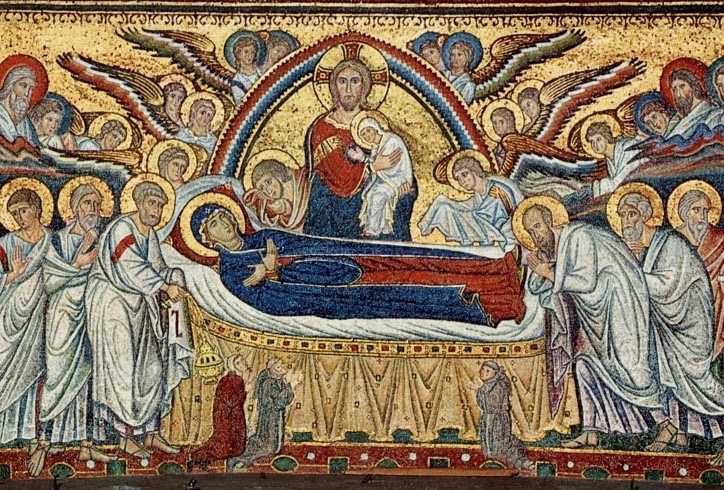
Since St. Mary is truly the mother of Jesus, then surely she must also be called the mother of God, since Jesus is God. Behold in her motherhood the mystery of the incarnation. For how can He who is the eternal God, ever blessed, have a mother? How can this virgin contain within her womb Him who holds all things? How can a creature bear the Creator? Reason will never know, but faith must bend the knee, believing, and say, Mary bore God, held God in her arms, and nursed God at her breast; Mary laid God in an infant bed, made soup for God, yea, was mother to God in every way proper for a mother to be a mother.
For in this is the reality of the incarnation: God Himself has become flesh, our flesh. Since this is so, He must also have a mother. Thus all motherhood is sanctified in this, and serves to show forth the humble manner in which our salvation was wrought. And all generations must call this virgin blessed, since she has now in truth become the mother of all who are in Christ. And as she was of lowly state, in order that Christ might be born of lowly state, so also must we all humble ourselves and consider the lowly state of faith to be truly high in the sight of God. (Burnell Eckardt, from “Every Day Will I Bless Thee: Meditations for the Divine Office”)
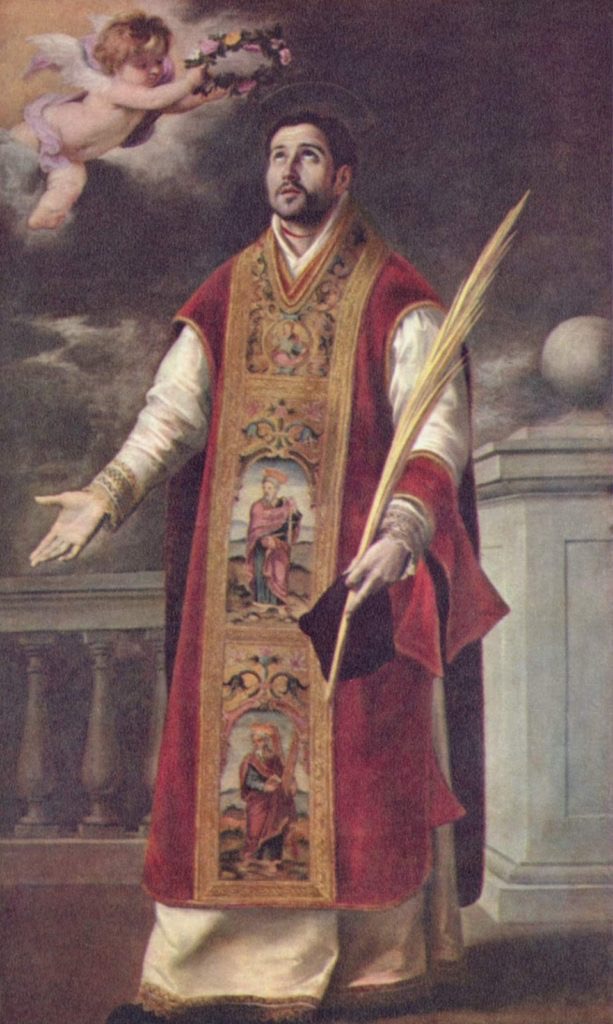
During the persecution of Christians under the Roman emperor Valerian in the year 258, Roman officials ordered Lawrence, a deacon, to bring them the treasures of the Church. Lawrence obediently spent the next three days gathering together the poor people who were supported by the Church. When he presented these poor people to the prefect, explaining that they were the true treasures of the Church, the prefect was not amused by the irony. He had Lawrence slowly burned to death over a great gridiron. During this torture, Lawrence made the famous reply that he was done on that side and could be turned over. After having prayed for the conversion of the city of Rome in order that the Christian faith might spread throughout the world, Lawrence died. The example of his life and death made a great impact on the people of Rome, and many became followers of Christ. Lord, show us how to love and serve the poor like Saint Lawrence.
(Adapted from “Saints: Becoming and Image of Christ Every Day of the Year,” by Dawn Beutner)
On this day, the Church commemorates St. Patrick, Missionary to Ireland. It is good to remember this well-loved and best-known missionary saint for his life and work. He was born to a Christian family in Britain around AD 389. Captured by raiders as a teen, he was forcefully taken to Ireland and forced to work as a herdsman. He escaped after six years of imprisonment and entered a monastery in France. He was ordained as a bishop and is believed to have returned to Ireland in 433 AD, where he spent the rest of his life proclaiming the Gospel and founding Christian communities. He was a defender of the doctrine of the Holy Trinity during a time when the doctrine was under attack. He wrote many contributions, including his autobiography and prayers and hymns that are still used today. He is believed to have died on March 17, AD 466 in Ireland.
“I bind unto myself the name, The strong name of the Trinity, By invocation of the same, The Three in One and One in Three. By whom all nature hath creation, Eternal Father, Spirit, Word: Praise to the Lord of my salvation, Salvation is of Christ the Lord.” –From St. Patrick’s Breastplate
Description adapted from, and St. Patrick’s Breastplate quoted from: “Treasury of Daily Prayer,” 1285-1286.
The story of Eulogius is one of constant, faithful Christian confession under the hand of Muslim persecution. By the middle of the ninth century, the Muslim Moors had taken over almost the whole of Spain. Christians were allowed some latitude to remain in their faith, as long as they did it quietly and didn’t offend the name of Muhammed (which would carry the death penalty). However, they were heavily taxed, mocked, and otherwise poorly treated. Eulogius was a priest in Cordoba, Spain at the time–a devout, gentle, reverent, well-educated priest steeped in the Sacred Scriptures–who cared deeply about the plight of the Christian people. During this time, an increasing number of young people began to have a more passionate zeal for the Christian Faith, to the extent that they were growing weary of having to keep quiet about it. They saw it as disingenuous to keep their faith secret. After all, Jesus said, “Whoever confesses me before men, I will confess before my Father in heaven; but whoever denies me before men, I will deny before my Father in heaven.” As their passion for the faith grew, the threat of martyrdom grew also. In fact, many of these young “radical” Christians were willing and even glad to die a martyr’s death for the sake Christ. Eulogius advised them and, at times, protected them. As time went on, he would also accompany them to their execution and later write the story of their faith and life. Dozens upon dozens of Christians were killed in Cordoba alone during this time (the 850s). They were accused of insulting Muhammad or something similar. Eulogius wrote many of their stories, showing the bravery and steadfastness with which they confessed their hope in Jesus. Eventually, Eulogius himself was taken prisoner and condemned to death. According to Butler’s Lives of the Saints, “arriving at the place of execution, he knelt down, extended his arms, made a large sign of the cross, prayed silently, and offered his neck to the sword.” Eulogius was put to death March 11, 859.”
Patrick Hamilton was a young professor at the University of St. Andrews in Scotland. Related to Scottish royalty through both parents, he studied in Paris where he read Erasmus and Luther and was convinced of the need to reform the Church of corruption and restore its proper focus on the Gospel. As professor, Hamilton attacked the ongoing moral abuses of many of the clergy, as well as false doctrine and abusive ecclesiastical practices. He came to the attention of Archbishop Beaton at the Cathedral who determined to arrest Hamilton for heresy. Upon the advice of friends, Patrick escaped to the continent where he travelled immediately to Wittenberg to hear Luther in person.
Upon returning to St. Andrews, Hamilton was (strangely, and perhaps underhandedly) invited to preach. He proclaimed salvation by faith alone, exerting great influence among the students, monks, priests, and professors of St. Andrews. Although warned by his friends, Patrick refused to flee and was quickly arrested and hauled before a council of monks, priests, and other clerics under the influence of Beaton. Patrick stood solidly on the Word of God and refused to back down on seven major charges that were central tenets of the Reformation’s evangelical catholic theology. He also denied the existence of Purgatory and affirmed the pope as an antichrist. He denounced relics as having any merit, in a town with a cathedral that boasted relics of great merit for pilgrims to pay to see, under the altar.
When offered his life for a recantation Patrick Hamilton replied: “As to my confession, I will not deny it for the fear of your fire, for my confession and belief is in Christ Jesus. Therefore I will not deny it. I will rather be content that my body burn in this fire for the confession of my faith in Christ, than my soul should burn in the fire of hell for denying the same.”
On the 29th of February, the twenty-four-year-old college professor was burned at the stake at the portico to the University while his students stood in shock, and the Franciscan friar teased him to call on the Virgin Mary to help him out. Upon his death, many others took up the cause of the martyr and spread the Gospel across Scotland. (Adapted from The Martyrdom of Patrick Hamilton, 1528, by Bill Potter)
From the Church father Tertullian: After one of the apostles was cut off, Christ commanded the eleven others to “go and teach all nations and baptize them into the Father, and into the Son, and into the Holy Spirit.” The apostles (which means “sent ones”) immediately started doing this. Having chosen Matthias as the twelfth apostle in the place of Judas, on the basis of the authoritative prophecy found in a psalm of David, they received the promised power of the Holy Spirit for the gift of miracles and preaching. They established churches throughout Judea, by bearing witness to the faith in Jesus Christ. Then they went out into the world and preached the same doctrine of the same faith to the nations, establishing churches in every city, from which all the other churches, one after another, received the tradition of faith and doctrine. Every day there are more churches being established. This is precisely why only these churches are able to call themselves apostolic, because they are the offspring of apostolic churches. . . . Therefore, though there are so many churches, they all comprise the one original church founded by the apostles. In this way, they are all originally apostolic and one, in unity, peaceful communion, and are brothers in the bond of hospitality, privileges which derive from no other rule than the one tradition from the same mystery.
From this we draw up our rule of faith . . . all doctrine that agrees with the apostolic churches, which are the molds and original sources, must be regarded as the truth that contains what was received from the apostles, the apostles from Christ, and Christ from God. All doctrine must immediately be regarded as false that has the taste of being different from that which the churches received from the apostles, from Christ, from God.
A brief biography: St. Matthias, one of the lesser-known apostles, was chosen by lot to fill the vacancy in the Twelve after the death of Judas Iscariot (Acts 1:16-25). According to early Church tradition, Matthias was among the seventy-two sent out by Jesus (Luke 10:1-20). Although little is known about his missionary journeys, historical accounts place him in various locations such as Ethiopia and Armenia, the first nation to embrace Christianity as its national religion. Tradition holds that Matthias was martyred for his faith, with some accounts pointing to Colchis in Asia Minor as the place of his death around AD 50. The Church of St. Matthias in Trier, Germany, claims to be his final burial site, making him the only one of the Twelve to be laid to rest in Europe north of the Alps.
Serenus, a native of Greece, was born during the reign of Emperor Maximian. He chose to renounce all his possessions and lead a life of asceticism and prayer. He sustained himself by living off the produce of his garden in Syrmium, located in the province of Pannonia (Mitrovica in present-day Croatia). During a period of persecution against Christians, he concealed himself for several months, but later resumed his quiet life in the garden, keeping his Christian faith unknown. Being a handsome and diligent young man, he earned the respect of all who crossed his path, especially that of the wife of one of Maximian’s guards. She went from showing regard to making unwelcome advances towards him.
Serenus admonished her, reminding her that it was unseemly for a lady to be seen outside during the dangerous hour of siesta, and that by doing so, she was needlessly dishonoring herself and her husband. Spurned by his rebuke, she wrote to her husband, falsely accusing Serenus of insulting her. The husband journeyed to Syrmium, presented the letter to the governor, and thus initiated a trial against Serenus. However, he defended himself so ably that the lady’s husband became convinced of his wife’s wrongdoing, leading to the withdrawal of the charge against Serenus.
Despite being cleared of the accusations, the suspicion of the governor was aroused, for he believed that anyone so conscientious in such matters must be a Christian. Serenus was charged with this and was urged to make a sacrifice to the pagan gods. Firm in his faith, he unhesitatingly professed his Christianity, refused to offer sacrifice, and expressed a willingness to die, declaring, “I may have a part in His Kingdom with His saints.” His wish was swiftly granted, as he was beheaded. It happened about the year 307. (Adapted from Butler’sLives of the Saints)
St. Faustinus and St. Jovita, born into a noble family in Brescia, Italy in the early second century, exemplified unwavering devotion to God from a young age. They fearlessly professed their Christian faith during the persecution of Hadrian, earning widespread recognition for their deep piety. Ordained by the bishop, Faustinus served as a priest while Jovita became a deacon. According to tradition, as they fearlessly preached the Gospel in the region, they were apprehended by a pagan officer named Julian. In the face of pressure to worship the sun, they boldly proclaimed their adoration for the living God, who had created the sun to illuminate the world. Their steadfast faith led to torture and, ultimately, their beheading around the year 120.
St. Valentine resided in Rome under the reign of Emperor Claudius. A skilled physician and a devoted priest, he emerged as one of the most revered martyrs of the third century, meeting his martyrdom in the year 270. The tale recounts that on the day of his execution due to his unwavering Christian faith, he left a message of encouragement for the child of his jailer. The note, inscribed on an unusually shaped piece of parchment, became the prototype for the heartfelt messages and cards exchanged in what numerous nations now commemorate as Valentine’s Day. Other stories and traditions suggest that St. Valentine fervently worked to convert pagans, an effort that was not well-received by the pagan Roman government. Additionally, it is said that he united Christian couples in matrimony, defying the prohibitions set by the pagan regime, hence earning him the esteemed title of the patron saint of the married and those in love. (adapted from Treasury of Daily Prayer)
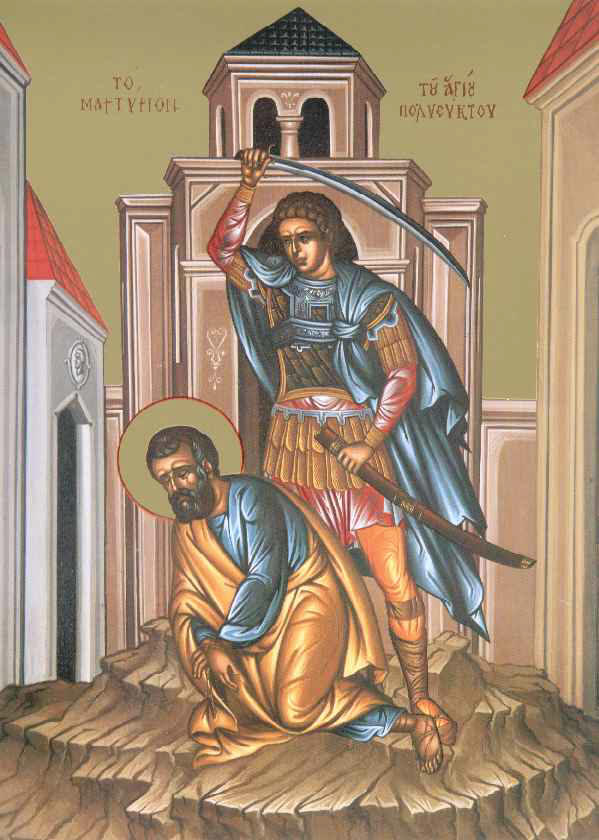
Already by 377, there is a church in Melitene in Armenia dedicated to the memory of Polyeuctus. He came from a Greek family and was an officer in the Roman army. He was converted to faith in Christ by a Christian friend. Subsequently, the two were arrested, tortured, and condemned to death, possibly during the persecution of Decius, emperor from 249 to 251, or, as more generally accepted, in the year 259 under the emperor Valerian. In a way akin to Saint Job in the Old Testament, the Acts of Polyeuctus include entreaties from his wife (and son) for him to give up and give in to the torture, i.e. to renounce Christ, in order to escape martyrdom. But it is said that the more they did so, the more he urged his wife to abandon her idols and cling to Christ. Polyeuctus was eventually beheaded for his faith.




 Catholic Jonesboro