
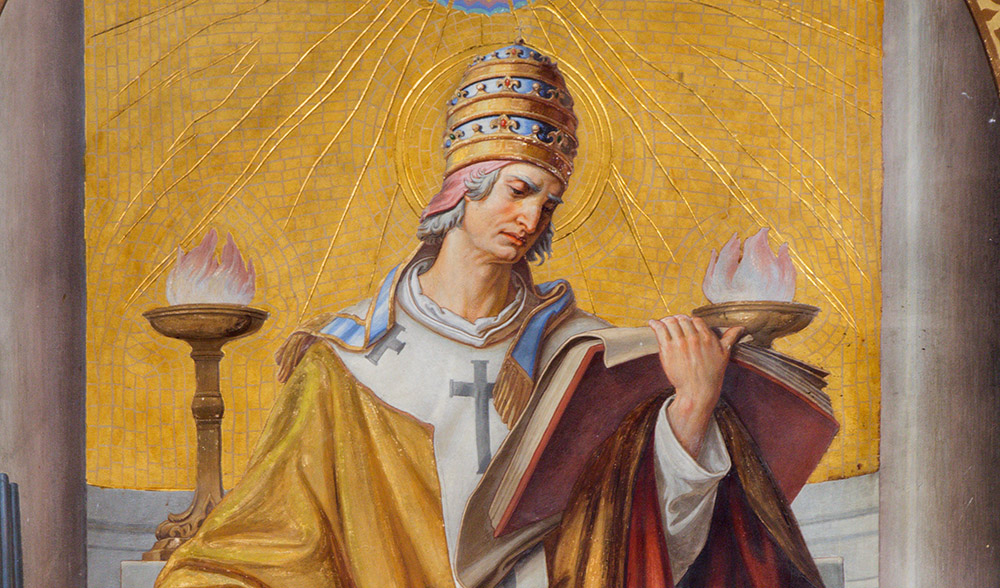
St. Gregory was born into a wealthy Christian family in the year 540. As a young man he studied law and quickly became governor of Rome as a result of his superior legal acumen. However, God ultimately led him to serve the Church through his talents and resources.
After the death of his father, Gregory turned his villa into a monastery dedicated to St. Andrew and took up the monastic life for himself. What he didn’t spend on religious buildings he gave away to the poor. Gregory’s dedication to charity and almsgiving lasted his whole life, but Gregory was not destined to remain a monk. He reentered the public sphere and was ordained a deacon by Benedict I and later ascended to the bishopric of Rome following the death of Pope Pelagius. During this time disease broke out, turning Gregory’s attention not only to his new role, but especially to the needs of the sick and needy in the face of an epidemic.
Gregory also is known for instituting the first ever large-scale mission work from Rome, known as the Gregorian mission, to convert the pagan Anglo-Saxons in Britain to Christianity. His chosen missionary was a monk by the name Augustine, who became the first Archbishop of Canterbury, and was known as the “Apostle to the English”.
Gregory’s faith left him no option but to lead a life of servitude and humility, not only in regard to his neighbors but also in matters of the Church’s worship. His liturgical reforms were aimed at creating continuity in faithful worship, like when he had a companion to the missal made specifically for the priests and supported musical development in the Church. These had some influence on the simplified compositions created for choirs, what is known today as Gregorian Chant. Gregory’s habits of ensuring that the poor were served, creating concord with neighboring peoples, and sending out missionaries makes him stand out as an early Church father.
(Adapted from: Festivals and Commemorations, by Phillip H. Pfatteicher)
 Catholic Jonesboro