
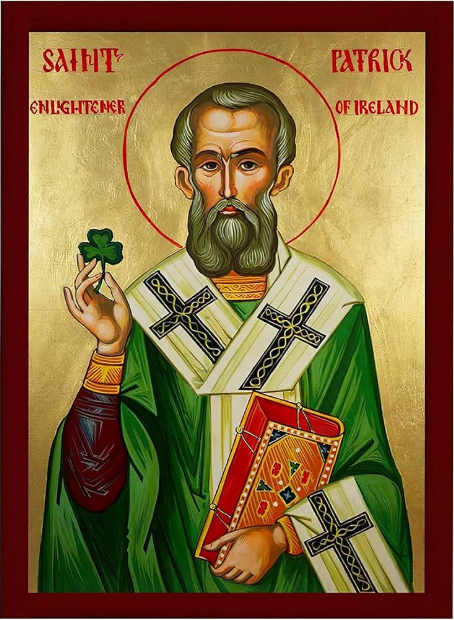
Saint Patrick was born in Britain around the time of the late 4th or early 5th century. His family were of modest means, his father being a Romano-British senator, tax collector, and deacon of the church. At some point in Patrick’s early life, probably his teen years, his family’s villa was raided by Irish pirates, and took him as a slave to Ireland. His captors had him tend sheep and he lived in horrible conditions. In his Confessio, an early autobiographical account of this life, he claims that while in his youth he was not particularly devout, he turned to God for strength in his captivity. Some years later, he escaped his captors, and convinced a boatman to sail him back to Britain to find his family. When disembarking, him and his party wandered the wilderness for weeks, nearly succumbing to starvation. His insistence that God would provide came to fruition, where the party finally happened upon some wild boar. This gained respect and trust from those around him, leading them to Christ.
During his early 20’s, Patrick continued to study Christianity and grow in his faith. One night he was given a vision, that he would return to Ireland and convert his captors. Acting upon this, he landed at county Wicklow in Ireland, where he was not welcome. He spent much of his early time in Ireland avoiding hostile pagan chieftains, but baptized and converted many to Christ throughout his travels. Legend says that during a sermon to the pagans, he plucked a clover from the ground near his feet and used it to explain to them the Trinity.
Eventually, Patrick arrived at the court of King Lóegaire, the high king of Ireland, where Druid priests displayed their demonic magic, theatrically plunging the hall into darkness. Instead of cowering in fright, Patrick observed aloud that these priests could create darkness but that they could not dispel it–which they could not. He then proceeded to use this incident as the theme of a sermon, in which he likened Christ to the light. Many of the assembled nobles converted to Christianity that day, and Patrick gained the king’s respect and protection.
In many ways, Patrick was more Irish than the Irish. He loved Irish legends, poetry and songs, and he insisted that this heritage be documented and retained. For their part, the Irish loved him and embraced him. Patrick lived his life in Ireland and died there. He left behind a Christian people, a civilized people, and he left behind towns, schools, seminaries and a love of learning perpetuated to this day.
The text of [Lutheran Service Book 604], “I Bind unto Myself Today,” is attributed to St. Patrick. This beautiful prayer, traditionally called “St. Patrick’s Breast-Plate,” is supposed to have been composed by Patrick in anticipation of his victory over paganism. The translation of the prayer in [Lutheran Service Book] from the old Irish text is a paraphrase by Cecil F. Alexander [1818-95]. The “Apostle of Ireland,” as Patrick is sometimes called, is also associated with the shamrock, which he used to explain the Trinity. “I Bind unto Myself Today” also deals with the topic of the Holy Trinity.
“I bind unto myself the name,
The strong name of the Trinity
By invocation of the same,
The Three in One and One in Three,
Of whom all nature has creation,
Eternal Father, Spirit, Word.
Praise to the Lord of my salvation;
Salvation is of Christ the Lord!“
(Adapted from John Murphy Ball (March 1999), “In Search of St. Patrick”, Lutheran Witness. Hymn stanza for “I Bind unto Myself Today” (LSB 604): public domain.)
 Catholic Jonesboro